- Home
- Funding and Coverage
- NDIS Funding for Mobility Scooters
NDIS Funding for Mobility Scooters: Your Friendly Guide to Getting the Right Support
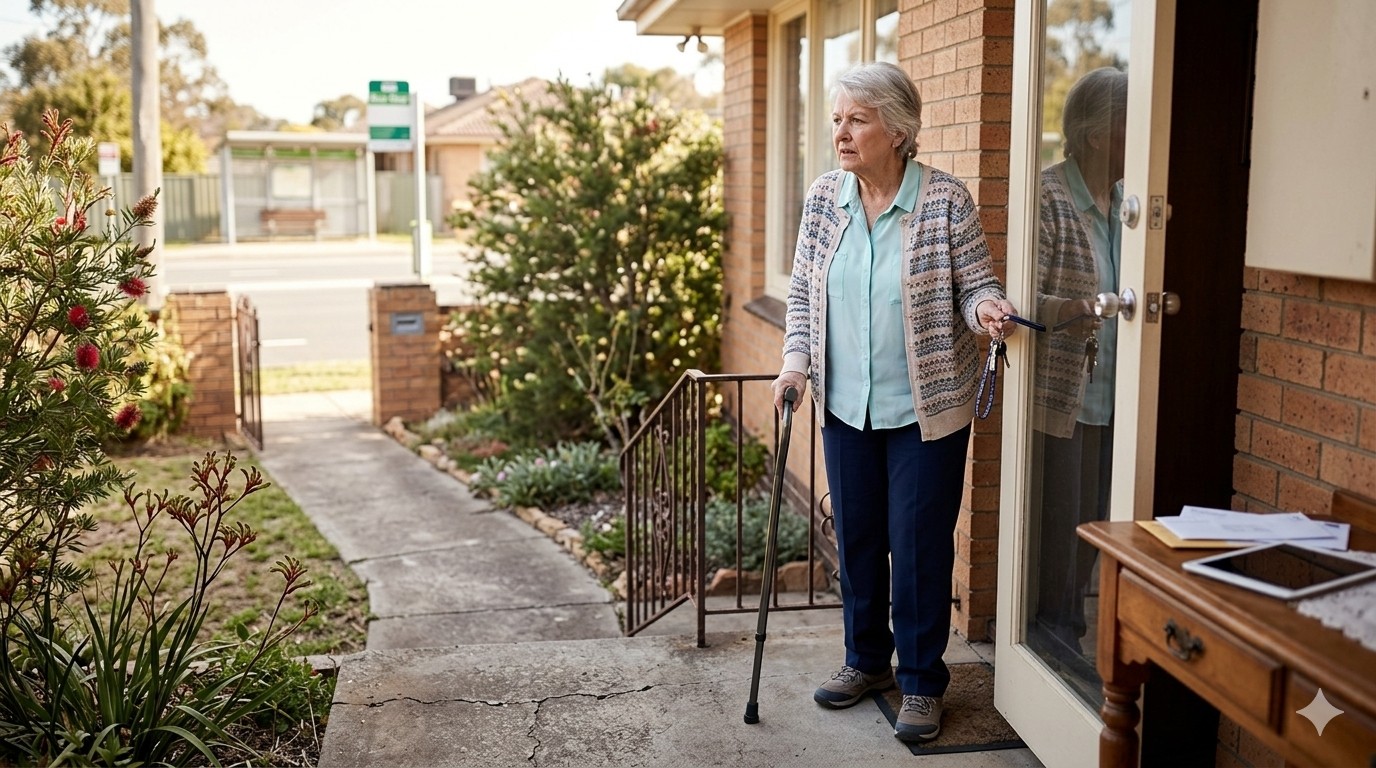
Picture this. You're standing at the front door, keys in hand, ready to head down to the shops. The walk used to be easy. Now it feels like a mountain — your legs ache, your breath shortens, and the distance between your front gate and the bus stop seems to stretch further every week.
You've heard the NDIS might help with a mobility scooter. But every time you look it up, the information feels like it's written in another language. Forms. Assessments. Quotes. "Reasonable and necessary." You close the laptop and tell yourself you'll figure it out another day.
This page is for that moment. NDIS funding for mobility scooters is genuinely achievable — thousands of Australians have been approved, and many more will be. But the process can feel opaque, and that opacity is exhausting.
So let's take it slowly, together. By the end of this guide, you'll know exactly what's possible, what's required, and what to do next. No jargon walls. No vague reassurances. Just clear answers.
Can the NDIS Fund a Mobility Scooter? The Short Answer
Yes — the NDIS can fund a mobility scooter when it meets the "reasonable and necessary" criteria. Mobility scooters fall under Assistive Technology (AT), which sits in your Capital Supports budget. This isn't a fringe benefit or an edge case — it's a core part of what the scheme was designed to do: help people with disability live more independently.
Most mobility scooters sit in the mid-cost AT range, between $1,500 and $15,000 per item. That matters because it determines the evidence you'll need. But here's the good news: the pathway is clearer than it looks. In the next section, we'll unpack what "reasonable and necessary" actually means in practice — because once you understand that phrase, everything else falls into place.
What "Reasonable and Necessary" Really Means for Your Scooter
Let's be honest: "reasonable and necessary" is one of those phrases that sounds official but explains very little. In practice, it means your scooter needs to be directly related to your disability, help you live more independently, support your community participation, represent good value for money, and not be something another government service should cover. That's the framework. But the real question most people have is simpler: "How do I prove it?"
Here's where things get interesting — and where a major court ruling has changed the game. In February 2026, the Federal Court handed down a decision that clarified something crucial: if you have multiple impairments, the NDIA cannot reject your scooter request simply because the need arises from a combination of factors. As long as at least one of your qualifying impairments contributes to the need, that's enough. The court called it a "contributory cause" — not the sole or dominant cause.
This was a landmark moment for people with multiple disabilities, and it's worth understanding what it means for you. (We break it down fully in our guide to the Eastham ruling and what it means for your NDIS scooter request.)
But for now, the takeaway is this: you don't have to prove your mobility issue is your "main" disability. You just have to show it's genuinely part of the picture.

Scooter or Powered Wheelchair? Getting This Decision Right
This is the question that trips up more people than any other — and it's not just about preference. Your choice affects your assessment, your evidence, and your funding pathway. Mobility scooters are built for people with good upper-body strength who mainly travel outdoors, need to cover longer distances, and don't require full-time postural support. Powered wheelchairs are better suited for people who need indoor manoeuvrability, have limited upper-body function, or need seating support for extended periods. Some participants end up with both — a wheelchair for home, a scooter for community outings.
If you're not sure which fits your life, don't guess. This is the perfect thing to explore during your OT assessment. (We explore the full decision framework — including how to justify your choice to the NDIS — in our dedicated guide to mobility scooters vs powered wheelchairs.)
The right answer isn't the most expensive one. It's the one that matches how you actually live.
The Assessment and Evidence You'll Need (Without the Overwhelm)
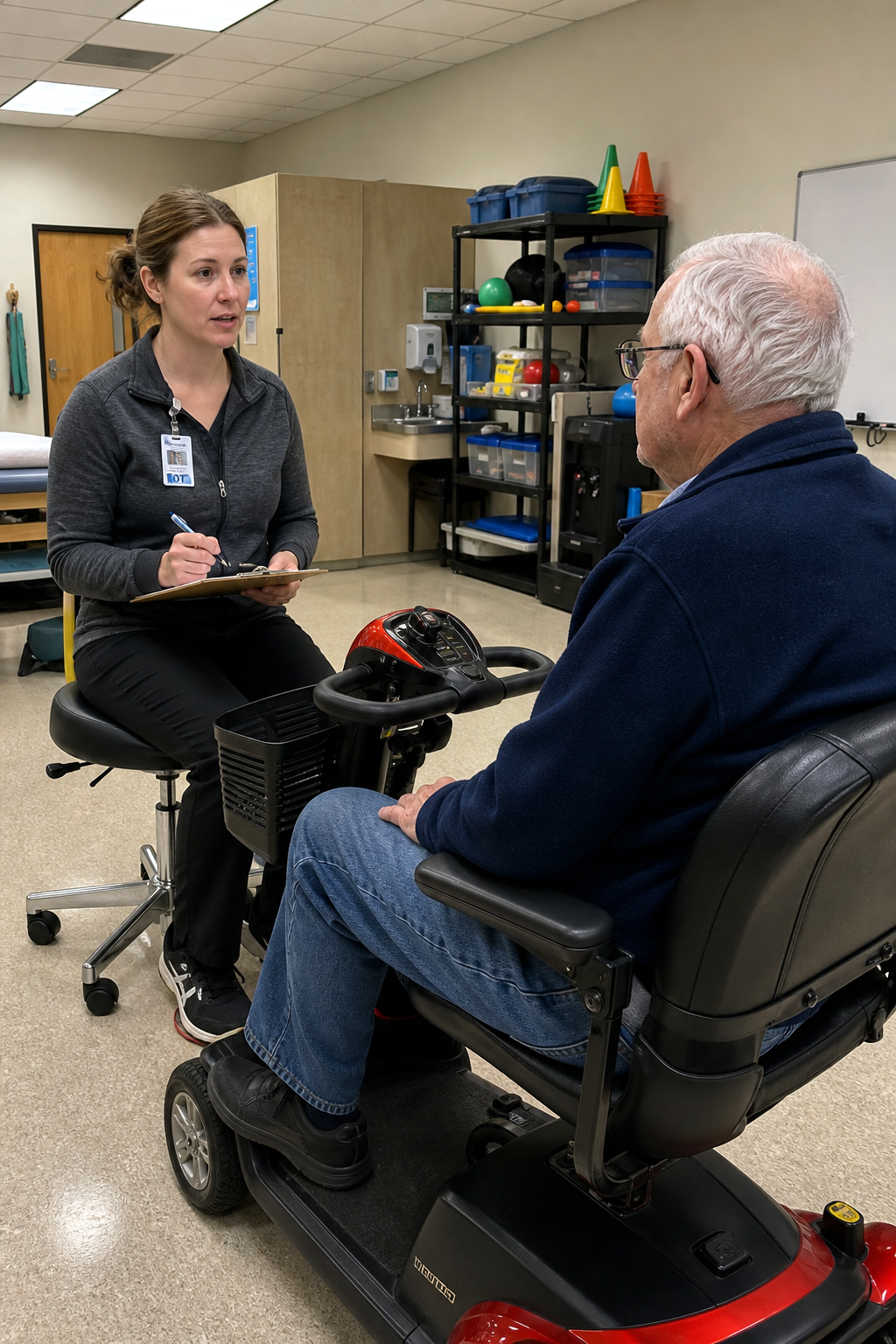
For equipment over $1,500 — which includes most scooters — you'll need a written assessment from an Occupational Therapist or Physiotherapist. This isn't optional, but it's also not a hurdle designed to catch you out.
Think of it as your OT building the case with you. They'll assess your mobility, strength, and functional limitations. They'll evaluate your home and community environment. They'll recommend the type of equipment that suits you and explain why. And they'll complete a report that speaks the NDIA's language.
The quality of that report matters more than almost anything else. It needs to link your impairment to your functional limitations, then to your real-life environment, and finally to why this specific piece of equipment is the right solution. If you're wondering exactly what to include — and how to make sure your OT report ticks all the boxes — we've created a full NDIS mobility scooter funding checklist that walks you through it.
What you need to know right now is this: you're not doing this alone, and the evidence process is more straightforward than it feels.
Costs, Quotes, and How NDIS Funding Tiers Work
Mobility scooters typically fall into the mid-cost AT tier, which means you'll need written evidence but — importantly — you do not need three quotes anymore. If you know what you want and it's within reasonable pricing, one quote from your chosen supplier is sufficient. That's a change that has simplified the process for a lot of people.
Cost ranges vary: basic models start around $2,400, while quality mid-range scooters sit between $3,000 and $6,000, and heavier-duty options can go higher. The funding tier determines the documentation required, but it doesn't change your eligibility. If your scooter is reasonable and necessary, it can be funded.
We go deeper into how the tiers work — and what changes at each level — in our guide to NDIS assistive technology funding tiers.
For now, the key is this: the cost doesn't disqualify you. It just shapes the paperwork.
How to Apply for NDIS Mobility Scooter Funding: Step by Step
The application process has six practical stages.
First, make sure mobility is written into your NDIS goals — be specific about how a scooter will help you travel independently, attend appointments, or participate in community life.
Second, complete your OT or physio assessment.
Third, trial equipment — this is strongly recommended and can be funded through your plan.
Fourth, get your quote and submit your application with all supporting evidence.
Fifth, wait for approval. Timelines vary widely — anywhere from two weeks to several months, depending on complexity and NDIA workload.
Sixth, once approved, purchase and set up your equipment.
It sounds like a lot when it's listed like that. But each step is manageable on its own, and you don't have to hold the whole process in your head at once. What happens after approval is its own chapter — and one most guides skip entirely.
We cover ordering, invoicing, delivery, set-up, and training in our guide to what happens after NDIS approves your mobility scooter.
For now, let's talk about the thing nobody wants to think about but everyone deserves to be prepared for.
If the NDIS Says No: Your Options (and Why There's Real Hope)
A refusal is not the end. It feels like it — it really does — but it isn't. You have the right to request an internal review within three months of the decision. If the internal review doesn't go your way, you can escalate to the Administrative Review Tribunal (ART) for an external review.
This is a formal process, but it's navigable, and people win appeals. The Eastham case itself went through internal review, then the ART, then the Federal Court — and the participant won at every stage. That's not to say every appeal succeeds. But it is to say that a "no" is a position, not a verdict.
We've laid out the full appeals pathway — including what evidence strengthens a review — in our guide to appealing an NDIS mobility scooter refusal.
And if your refusal was based on the idea that your mobility issue isn't your "qualifying" impairment, the Eastham ruling may be directly relevant to your situation.
Keeping Your Scooter Running: Repairs, Servicing, and Batteries
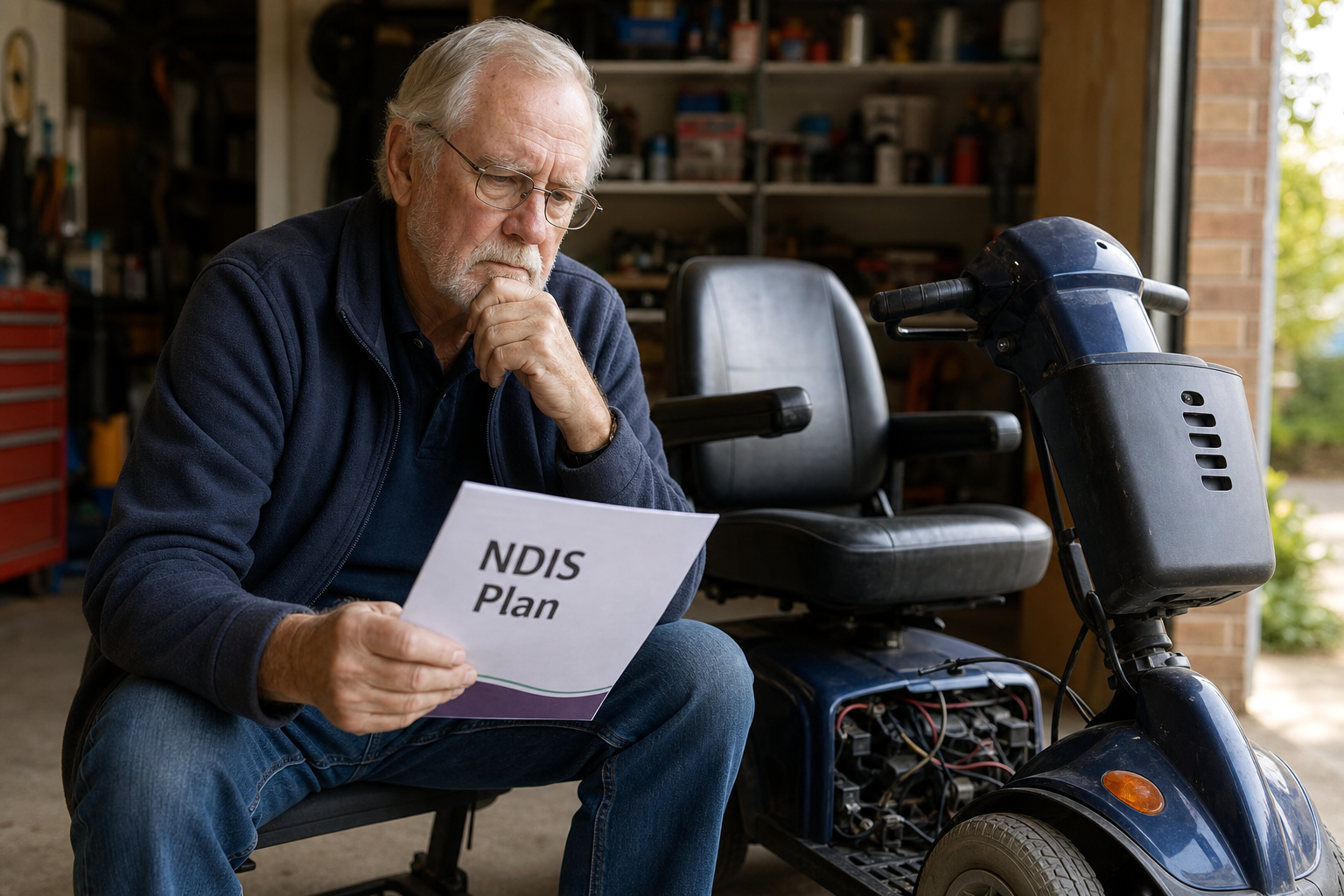
Your scooter isn't a one-time purchase — it's an equipment that needs care. The good news is that the NDIS funds repairs and maintenance for AT items you're currently using. That includes routine servicing, replacement batteries, tyres, chargers, and labour for repairs.
These costs sit in your Capital Supports budget under "assistive technology repairs and maintenance." If something breaks urgently, there's also a provision for urgent repairs. This is one of the most under-discussed parts of NDIS scooter funding, and understanding it upfront saves stress later.
We've put together a full guide to NDIS funding for scooter repairs, servicing, and replacement batteries if you want the detailed breakdown.
The short version: you're covered for keeping your equipment safe and functional, not just for buying it in the first place.
FAQs About NDIS Funding for Mobility Scooters
Can I choose my own mobility scooter brand or supplier?
Yes — you can choose your preferred supplier, though agency-managed participants must use NDIS-registered providers. Plan-managed and self-managed participants have more flexibility.
Can the NDIS reimburse me if I already bought a mobility scooter?
Generally, the NDIS does not fund retrospectively. If you purchased before approval, reimbursement is unlikely unless there are exceptional circumstances. Always seek approval first.
Can I buy a second-hand mobility scooter with NDIS funding?
Yes, the NDIS may fund second-hand or refurbished equipment if it meets your needs and represents value for money. Your OT assessment still needs to confirm suitability.
How long does NDIS approval for a mobility scooter usually take?
Timelines vary from a few weeks to several months. Mid-cost AT requests are often faster than high-cost or complex ones. Your support coordinator can help track progress.
Can the NDIS fund mobility scooter accessories like ramps or holders?
Yes, some accessories can be funded if they're directly related to your disability and support your mobility. Speak with your OT about which items fall under your plan.
Can plan-managed or self-managed participants buy a scooter differently?
Yes. Self-managed participants can pay upfront and claim reimbursement; plan-managed participants work through their plan manager; agency-managed participants must use registered providers.
What should I do if the NDIS says no to a mobility scooter request?
Request an internal review within three months. If that fails, you can apply to the ART for an external review. You have options — and you're not alone.
Your Next Step (and Why You Don't Have to Figure This Out Alone)
If you've read this far, you've already done the hardest part: you've started. The NDIS funding process for mobility scooters is not simple, but it is navigable.
You don't need to memorise every rule or predict every question. You need a clear next step: talk to an OT, start gathering your evidence, and reach out to your support coordinator if you have one. If you don't, your local area coordinator can help you find your way.
A mobility scooter isn't just equipment. It's the shops you'll visit without pain. The friends you'll see without planning three days in advance. The appointments you'll attend without asking for a lift. It's independence — and it's worth pursuing.
You've got this. And now you've got a map.
Stay mobile, stay confident!
Sign up for our monthly Mobility Scooter Newsletter to receive practical guides, expert advice, and inspiring stories that help you make the most of your scooter and download our free "Mobility Scooter Guide for Beginners."
Don't worry — your e-mail address is totally secure.
I promise to use it only to send you our newsletter, "Mobility Matters."
Recent Articles


-
The NDIS Mobility Scooter Funding Guide I Wish Someone Had Given Me
Sep 24, 26 09:26 AM
 NDIS funding for mobility scooters doesn't have to be confusing. Here's your friendly guide to eligibility, assessment, costs, and approval.
 -
Mobility Scooter Buying Guides– No More Guesswork
Sep 24, 26 07:28 AM
 Mobility Scooter Buying Guides — don’t buy before reading this. Expert tips on features, safety, and getting the best value.
 -
Mobility Scooter Buying Guide: Don't Buy Until You Read This
Sep 24, 26 07:02 AM
Mobility Scooter Buying Guide: Confused by choices? We walk you through types, costs, test drives and car boot fit so you buy with total confidence.



Ready to Feel More Confident on Your Mobility Scooter?

My Ebook, The Ultimate Guide to Mobility Scooters, walks you through choosing the right scooter, using it safely, and keeping it in top condition — all explained in clear, friendly language.
Give yourself (or someone you love) the gift of independence.


